
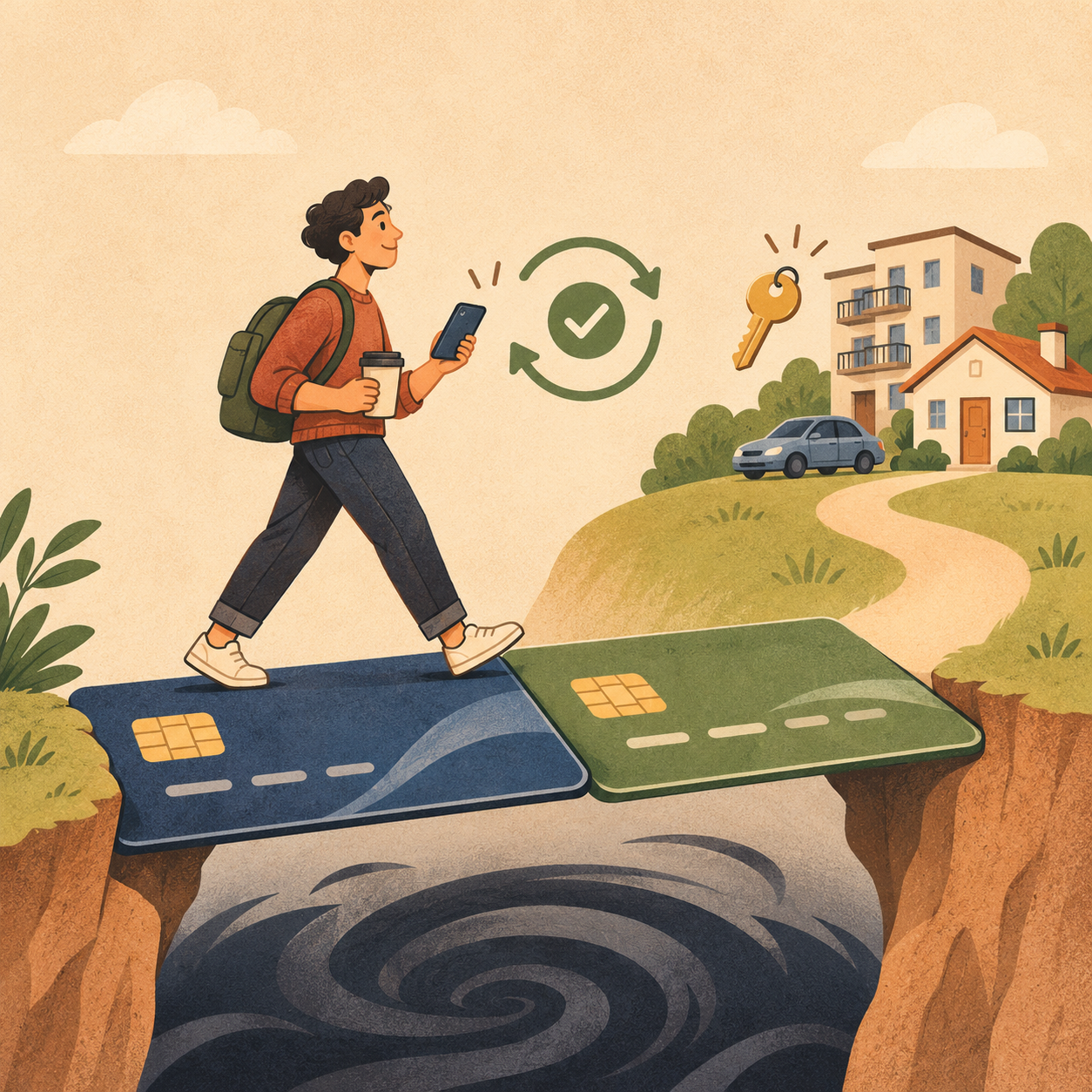
Yes, this is boring. No investment secret, tax loophole, or scandalous bank trick, just instructions for using a credit card.
But if you do not have a credit card, or proudly avoid one because “debt is bad,” you should probably continue reading. A credit card is not debt unless you turn it into debt. Used correctly, it is one of the simplest ways to build your financial reputation in America.
Five boring minutes today may save you years of unnecessary inconvenience and higher borrowing costs.
Action Plan: Build Credit Without Paying for It
Get a No-Annual-Fee Credit Card Early
Choose a card with no annual fee. You want to keep it for many years without paying for the privilege.
If you are rejected, do not take it personally. Try a couple more cards, but do not immediately apply to ten banks at once.
First, look for issuers that offer prequalification without a hard credit inquiry. If you absolutely cannot qualify for a regular card, consider a no-fee secured credit card. However, there is a good chance you will find a card that approves you soon after high school.
A credit card application may create a hard inquiry, but you have no established score yet, so there is not much to lose. We are playing the long game here.
Use It Regularly, but Never Carry a Balance
Use the card for ordinary expenses:
- Groceries
- Gas
- Phone bills
- Books or transit
Set up autopay for the full statement balance.
Paying the minimum is not enough. Carrying a balance does not improve your credit score. It merely pays for the bank’s nicer office furniture.
Keep the Reported Balance Reasonable
Lower credit utilization is generally better. Staying below 30% is a useful guideline, but 30% is not a magical boundary.
If your limit is only $500 or $1,000, ordinary purchases can produce high utilization. Paying part of the balance before the statement closes might help slightly, but right now there are bigger fish to fry. You are not applying for a car loan or mortgage yet.
Temporary high utilization may lower your current score, but the effect usually improves after a lower balance is reported.
Why You Are Doing This
You are building evidence that you can borrow responsibly, even when you do not need to borrow.
A good credit history can help with:
- Renting a home
- Obtaining better car loan or mortgage terms
- Setting up utilities with smaller deposits
- Hotel and rental-car reservations
- Certain finance or security-related jobs
- Fraud protection and purchase disputes
A credit card can help you pay during an emergency, but it is not an emergency fund. Borrowed money is not savings.
Rewards Without Nonsense
Start with a simple cash-back card.
Travel points can be valuable, but cash is easier to understand and harder to devalue.
Sign-up bonuses are useful only if you:
- Spend no more than you normally would
- Pay the statement balance in full
- Understand the issuer’s bonus rules
- Never pay interest to earn rewards
If you still choose points, do not accumulate them forever. Their value can change at any time.
Add Another Card Later
After establishing your first card and building a record of on-time payments, add another no-fee card within a few months.
A second card provides:
- More available credit
- Lower overall utilization
- A backup if one card is lost, frozen, or declined
- Access to a different payment network or issuer
TIP: The banks’ logic here may seem ridiculous, but this is what happens:
You get one card with a $1,000 credit limit and use $300 each month. Your utilization is 30%. Now suppose you apply for another card and receive a $2,000 limit. If you continue using only $300 across both cards, your overall utilization falls to 10%: $300 divided by the combined $3,000 limit.
Other banks may see you as a more attractive customer and approve you for even more credit.
Once your credit score improves and you can be more selective, get at least two cards with no foreign-transaction fees. Keep them in separate places. If one disappears, it should not take the other one with it.
Long-Term Rules
Keep your oldest no-fee cards open when practical. Account age can help your credit history.
You do not need to use every card regularly. Put it on the shelf and forget about it for a while. If it is not used for too long, the bank may send you a reminder to use it to avoid closure. Then you can use it once and be safe for another few years.
Ask for credit-limit increases as your income grows, or simply as time passes.
Do not chase an enormous credit limit merely as a trophy. The goal is enough available credit to keep utilization low and provide flexibility without creating bills you cannot manage.
TIP: Keeping utilization under 5% can help maximize your score. If your regular monthly expenses are about $2,000, a total credit limit of roughly $40,000 would keep that spending at 5% utilization. You do not need to reach that limit immediately, and you should never spend more merely to use your available credit.
What to Do Today
- Open a checking account if you do not already have one.
- Research a no-annual-fee card.
- Look for a simple cash-back card that offers prequalification.
- Apply for one appropriate card, not five random cards.
What to Do When It Arrives
- Activate the card.
- Set autopay to the full statement balance.
- Enable purchase and payment alerts.
- Make one small, necessary purchase.
- Confirm that the first automatic payment works.
Ongoing
- Review every statement.
- Request reasonable credit-limit increases as your income grows or simply as time passes. At the beginning, your credit profile will develop quickly, and you can make a lot of progress within the first year.
- Add another no-fee card from time to time until you reach a reasonably large overall credit limit.
- Pay every statement balance in full, every time.
The entire strategy is boring:
Get credit. Use it. Pay it. Keep it.
Boring is good when it works.
Comments
One response to “Your First Credit Card: Why It Should Not Be Your Last”
[…] Your First Credit Card: Why It Should Not Be Your Last […]