

Retirement may be more fun when your spending “slides” instead of “smiles”.
A question, only partly joking: What better describes retirement spending—a smile or a ski slope?
Imagine your retirement. No more work obligations. Plenty of time, and finally the freedom to do “it”—whatever “it” may be.
Naturally, you expect to spend more money. Perhaps considerably more. Financial advisors and cautious friends often reinforce this expectation:
Work longer. Save more. Wait until you finally have enough.
And the years go by while “enough” remains somewhere in the distance.
Many people never seriously calculate how much they need. Others hugely overestimate it, potentially sacrificing healthy years to chase an unnecessarily large target.
So let’s stop postponing the calculation and look at it now.
If you have done any retirement research, you may be familiar with the retirement spending smile: Spending starts high during the active early years, declines as people slow down, and rises again toward the end of life because of healthcare expenses.
But we are here to look at the numbers, because #NumbersMatter.
What happens when we actually measure retirement spending? Or better yet, when someone with real data measures it for us?
The surprising reality: No real smile in sight
J.P. Morgan Asset Management analyzed anonymized spending data from more than 280,000 American households. The results reveal several things that should change how we think about retirement planning.
Let’s look at the numbers.
1. The initial spike barely exists
The retirement spending spike is surprisingly small and brief.
For households with pre-retirement incomes of $50,000–$90,000, the research chart indicates an initial increase of approximately 5–10%.
Not 50%. Not double. Just a modest bump.
For households with pre-retirement incomes above $150,000, the average spending surge disappeared entirely.
Perhaps they were already allowing themselves to buy everything they wanted.
Even where the spike exists, it is brief relative to a retirement that may last 30 years. Spending rises around retirement and then gradually declines. Elevated spending may persist for several years, but hardly for a lifetime. It drops below the initial level fairly quickly.
Here is another surprise: The additional money is not going where we might expect. Take travel, for example. Did you dream about all those retirement cruises, exotic vacations, and adventures?
Travel is not even among the major categories driving the observed increase.
Let’s admit it and #RecognizeYourself. You may take several expensive trips after retiring, then discover that constant travel is more exhausting than liberating. One ambitious trip a year may be enough. The retirement we imagine and the retirement we actually enjoy are not necessarily the same.
The researchers find that the spending increase is concentrated in categories such as healthcare, apparel, and food.
Perhaps some retirees travel extensively while most do not. The averages cannot answer that question. But they certainly challenge the picture of retirement as one long, expensive vacation.
2. The “smile” is really a ski slope
Now zoom out from the retirement date and look at spending across the later stages of life.
Instead of the familiar retirement spending smile, the data looks remarkably like a ski slope: Spending declines substantially with age, then levels off, with only a slight upward turn at the very end.
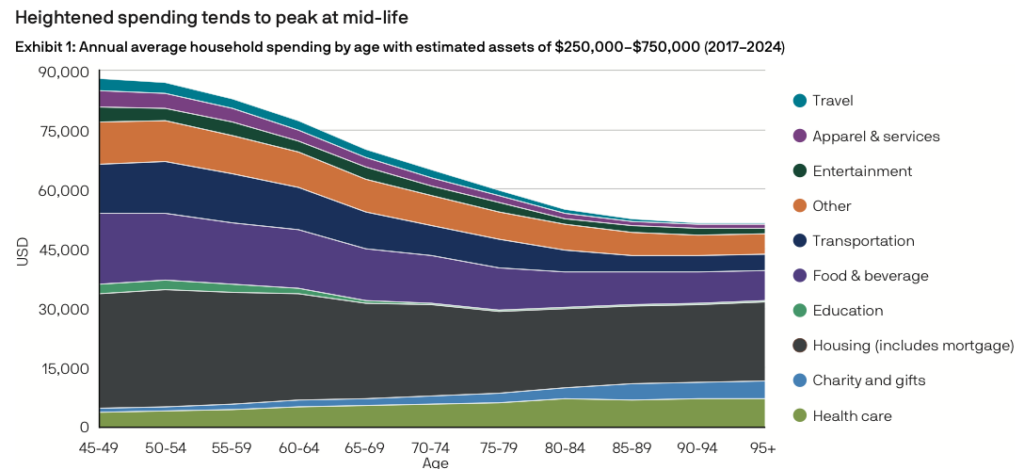
The dominant feature of the chart is not the eventual increase. It is the long decline, which makes the final increase almost disappear. #NumbersMatter.
And this matters enormously right now, when we are calculating how much money we need to retire.
If we assume that spending will remain high indefinitely and then increase significantly toward the end, we may conclude that we need considerably more money than our actual lifestyle will require.
That calculation can determine whether we retire now or continue working for another five or ten years.
3. The final bump is a minor blip, not a game-changer
Yes, spending may rise toward the end of life, particularly because of healthcare and long-term-care expenses.
But look at the scale. It is a tiny blip.
We do not know whether it will happen to us, when it might happen, or how much money we will still have at that point. The J.P. Morgan spending curve shows only a small late-life increase for the illustrated asset group.
Truly large late-life expenses are not an ordinary lifestyle. They are risks.
Risks should be addressed through risk-planning tools, including insurance-type products where appropriate, rather than by pretending that every year of retirement will be unusually expensive.
A possible large expense at the end of life is not the same as needing to finance an expensive lifestyle throughout retirement.
Now, let’s be practical and honest
Is your current life radically different from that of everyone around you? Is your car completely unlike your neighbors’ cars? Is your house much larger? Do you regularly visit upscale restaurants that nobody around you would consider?
If even your most visible spending choices are not particularly unusual, why should your retirement spending suddenly become extraordinary?
You are probably not one of a kind. You are probably more or less like the people around you, and your retirement spending may well follow the same broad statistical pattern.
That is not an insult. For once, it is great news.
Even if you dream of an exceptional retirement, consider the possibility that you could live quite happily with an ordinary one. You already do so in many aspects of your life.
The research data is not a crystal ball, but it is a remarkably useful time machine: a way to see how spending typically changes across the stages of retirement.
You can plan for something extraordinary while recognizing that an ordinary retirement remains a perfectly acceptable alternative for most people living a lifestyle similar to yours.
There is little reason to sacrifice years of freedom today merely to guarantee that you will never have to live an ordinary life tomorrow. Maybe the most extraordinary thing you can do now is retire at 55, leaving everyone amazed—and envious.
Accepting that your retirement may not be completely different from everyone else’s could save you from one of the most expensive mistakes people make: working too long, saving too much, and never managing to spend the money at all.
Before deciding that you need another million dollars to retire comfortably, perhaps it is worth finding out where, exactly, that million is supposed to go.
Research reference
- J.P. Morgan Asset Management (2025), Three New Spending Surprises: Additional Insights into Retirement Spending Behaviors.
- On the price of financial instruments
- The Six-Month Emergency Fund Everyone Recommends Is an Expensive Psychological Trick. Here Is Why.
- The Society Time Machine
- The Moving Line in Financial Security: From “Never” to “Why Not”