
The Costco Anywhere Visa has traditionally been a very good credit card for ordinary middle-class households: no annual fee beyond the Costco membership, and substantial rewards precisely where many families spend money: restaurants, gasoline, and travel.
Citibank is now trying to attach a different habit to it: financing ordinary purchases through Citi Flex Pay. And I feel surprisingly bad about it, almost ashamed to be a cardholder.
The bank suggests dividing purchases as small as $75 into monthly installments. So a typical $160 household purchase is suddenly presented as something qualifying for a “payment plan.”
The attractive headline is:
Pay $0 fee and no interest on any eligible Costco purchase of $75 or more when you select a three-month Citi Flex Pay Plan.
Then comes the asterisk.
The free offer applies only to eligible Costco purchases, only for three months, and only when Citi’s transaction coding recognizes the purchase appropriately. Goods and services provided by outside vendors do not qualify, including most Costco Travel purchases. Longer plans and purchases outside Costco may carry monthly Plan Fees.
The free three-month plan itself appears to be genuinely free. There is nothing inherently wrong with using it. A financially careful customer might reasonably click a few buttons to spread a large purchase over three months while keeping the money temporarily in savings.
Let’s assume that a typical middle-class family has the money, with income coming in steady chunks and expenses reasonably well planned. All they need is to flatten an occasional spending spike effectively.
But the financial gain is modest. Even on a $3,000 purchase, the additional return from delaying portions of the payment for only one or two months and not taking money out of the rainy-day fund is likely measured in tens of dollars, not hundreds.
I do not think that small benefit is the real product being sold.
The free plan invites customers to associate Citi Flex Pay with “no interest and no fee.” Once that association is established, the same name and nearly identical interface can offer fee-bearing plans on other purchases. The customer must notice that the terms have changed every time.
The few dollars earned by delaying one large purchase could easily be lost through fees on several smaller Flex Pay plans.
Watch the trick
Citibank calls the charge a “Plan Fee” rather than interest. Economically, the distinction is largely cosmetic.
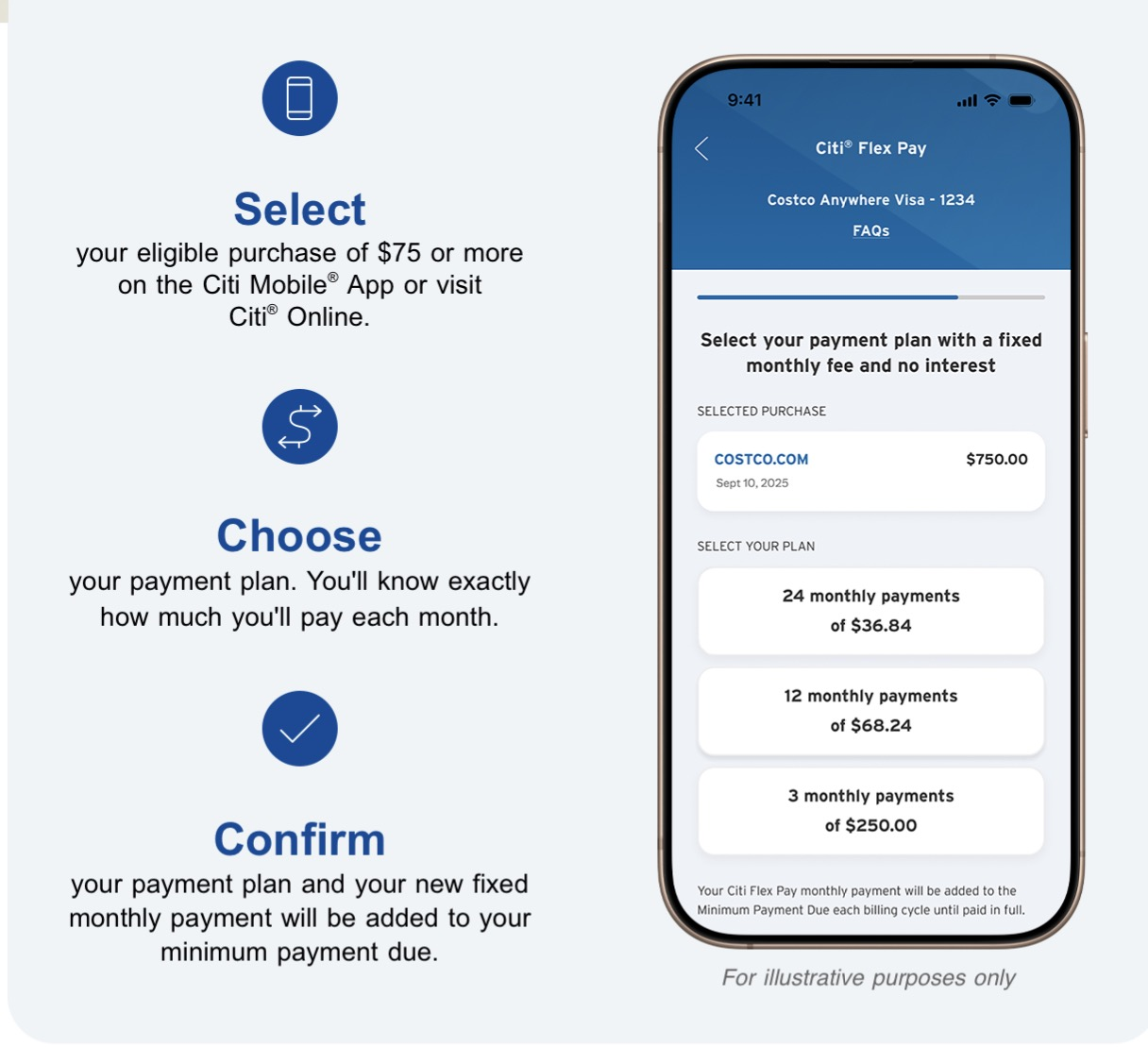
Citi’s own promotional image provides an excellent example. It shows a $750 Costco.com purchase with three options:
- Three payments of $250: $750 total
- Twelve payments of $68.24: $818.88 total
- Twenty-four payments of $36.84: $884.16 total
The three-month option is free. The twelve-month option costs $68.88, while the twenty-four-month option costs $134.16. Both paid plans represent an effective annual borrowing cost of roughly 17%–18%, assuming equal monthly payments.
That may be less expensive than carrying an ordinary credit-card balance. But it is still financing, not a free convenience. And the presentation directs attention toward the comfortable monthly payment rather than the total cost.
Citibank is not merely offering credit when a customer needs it. If someone needs a loan for a $75 purchase, a payment plan is not a solution. It is a warning.
Instead, Citi encourages customers to create a loan simply because a transaction already exists, while positioning the entire Flex Pay system alongside a narrowly restricted free offer.
It could be a genuinely good service
There are legitimate situations for Flex Pay. A necessary appliance, medical expense, emergency repair, or unexpected airline ticket may be substantially larger than the customer’s normal monthly bill.
Suppose a household normally charges $1,000 per month and suddenly faces a $2,500 necessary expense. Paying it immediately produces a $3,500 monthly bill. Dividing the unexpected expense into three free payments reduces the first month’s bill to approximately $1,833, with the remaining installments appearing over the following two months.
That is meaningful cash-flow protection. And that is the difference between helping customers absorb a financial shock and encouraging them to finance irresponsible consumption with the apparent goal of luring them into paying fees.
A genuinely customer-oriented benefit could provide three months of free financing for unusually large transactions, perhaps purchases above $1,000 or purchases exceeding the customer’s typical monthly spending, regardless of where they occur.
Note: Ironically, the expenses for which this protection would be most useful are often unlikely to come from Costco. Medical bills, car repairs, emergency travel, and specialized home repairs may all fall outside the free Costco offer.
Summary
Aggressively promoting installment financing for ordinary purchases above $75 does not look like financial flexibility to me. It looks like an attempt to invite loyal customers who previously used a straightforward rewards card into a financial adventure, and then collect fees when some of them fail to distinguish the narrowly free offer from the rest of the program.
The program may be legal, and the details may technically be disclosed. But using a genuinely free offer to encourage familiarity with fee-bearing installment borrowing feels ethically questionable, especially when attached to a trusted card used heavily by middle-class families.